
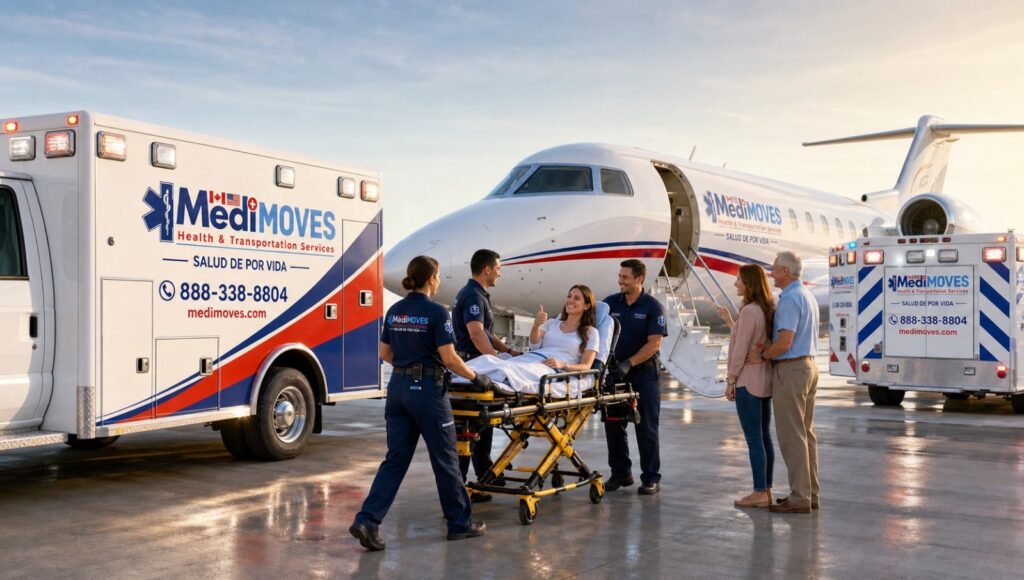
When a Canadian snowbird needs to get home from Florida for medical reasons, families face an urgent question: do you book an air ambulance, or arrange long-distance ground medical transport? Both will get your loved one home safely — but they differ enormously in cost, comfort, and the situations they suit. Here’s how to decide.
At a Glance
| Air Ambulance | Ground Medical Transport | |
|---|---|---|
| Typical cost (long trip) | Very high — often $12,000–$80,000+ | A fraction of air — often 75–95% less |
| Speed | Fastest — hours | Slower — about a day for FL→Ontario |
| Best for | Time-critical, unstable patients | Medically stable patients |
| Comfort | Cramped cabin, multiple transfers | Door-to-door, room to recline, family can ride |
| Medical level | Flight nurse / critical care | Trained attendant, paramedic, or Nurse level care available |
| Door-to-door? | No — ambulance to airport on both ends | Yes — bedside to bedside |
What Is an Air Ambulance?
An air ambulance is a private aircraft equipped as a flying intensive-care unit, staffed by a flight nurse or critical-care team. It is the right call when a patient is medically unstable or when time is genuinely critical — for example, a fresh cardiac event or a serious injury that needs urgent specialist care. Its great advantage is speed: Florida to Ontario becomes a matter of hours.
The trade-offs are cost and comfort. Air ambulance trips commonly run from roughly $30,000 to $80,000 or more, and very long international transfers can climb past $175,000. The cabin is cramped, and the trip still involves ground ambulance transfers at both the departure and arrival airports — so it isn’t truly door-to-door.
What Is Long-Distance Ground Medical Transport?
Ground medical transport moves the patient by road in a specially equipped vehicle — wheelchair-accessible or stretcher-capable — with a trained attendant on board for the whole journey. It’s designed for medically stable patients who don’t need an emergency flight but can’t manage a commercial plane or a long drive in a regular car.
The journey from Florida to southern Ontario is about 1,400 miles and takes more than a day, with planned rest stops and the patient cared for throughout. In exchange for the extra time, you get a far lower cost, a calmer and more private experience, the ability to bring a family member along, and genuine bedside-to-bedside service. Both non stop and overnight service is available.
The Cost Reality
For most non-emergency trips, this is the deciding factor. Ground medical transport typically costs a small fraction of an air ambulance for the same route — often 75–95% less. Many families begin by searching for an air ambulance, discover the price, and realize that for a stable patient a supervised ground transport delivers the same outcome — a safe arrival home — at a dramatically lower cost. If your loved one is stable, ground transport is usually the smarter financial choice by a wide margin.
When an Air Ambulance Is the Right Choice
Air ambulances exist for good reason. Choose air transport when the patient is medically unstable, when a doctor advises that time is critical, or when the distance is so great that many days on the road would itself be a risk. In these cases the speed and in-flight critical care are worth the cost. If you’re unsure, your physician or hospital discharge planner can advise on whether the patient is stable enough to travel by ground.
Why Ground Transport Suits Most Snowbirds
The majority of snowbird transport needs are not life-or-death emergencies — they’re stable patients who simply need to get home for ongoing care, recovery, or to be near family. For them, long-distance ground transport is usually the better fit: comfortable, affordable, door-to-door, and free of the airports and transfers that make air travel hard on someone who isn’t well.
A Word on Insurance
Provincial health plans cover very little outside Canada. Private travel and snowbird insurers may cover repatriation by air or ground, but typically require pre-authorization first, and may attach conditions for age or pre-existing conditions. Whichever option you’re considering, call your insurer early, ask specifically what they cover, and get approval in writing before the trip.
How MediMoves Helps
MediMoves is a long-distance ground medical transport specialist for the Florida-to-Canada route, backed by our Canadian Partner, CTG Medical’s 40+ years of experience. For stable patients, we provide a safe, affordable, door-to-door alternative to an air ambulance — wheelchair and stretcher vehicles, trained attendants, and coordinators who manage the discharge, insurance paperwork, and border crossing. Explore our long-distance medical transportation service or request a free quote to compare your options.
Frequently Asked Questions
Is ground medical transport safe for such a long trip?
Yes, for medically stable patients. A trained attendant cares for the patient throughout, the vehicle is equipped for comfort and mobility needs, and the route is planned with rest stops. Your doctor can confirm whether the patient is stable enough to travel by ground.
How much cheaper is ground transport than an air ambulance?
For the same route, ground transport often costs 75–95% less. Air ambulance trips commonly run $35,000–$80,000 or more, while a supervised ground transport is a fraction of that. Ask for a written quote to compare.
How do I know which one I need?
If the patient is unstable or time is critical, an air ambulance is appropriate. If they are stable and simply need to get home, not able to ambulate, need comfort care, ground transport is usually the better choice. Your physician or discharge planner can advise, and we’re happy to talk it through.
Can you coordinate with the hospital?
Yes, These trips are complex. We work directly with the discharging hospital, handle the documentation, and manage the border crossing so your family doesn’t have to. In some case Medi moves will conduct a pre arrival on site review to ensure you are fully prepared.
Compare Your Options with MediMoves
Before you commit to an expensive air ambulance, talk to us. Call 888-338-8804, 24/7, or request a free quote — we’ll help you choose the safest, most cost-effective way to bring your loved one home to Canada.